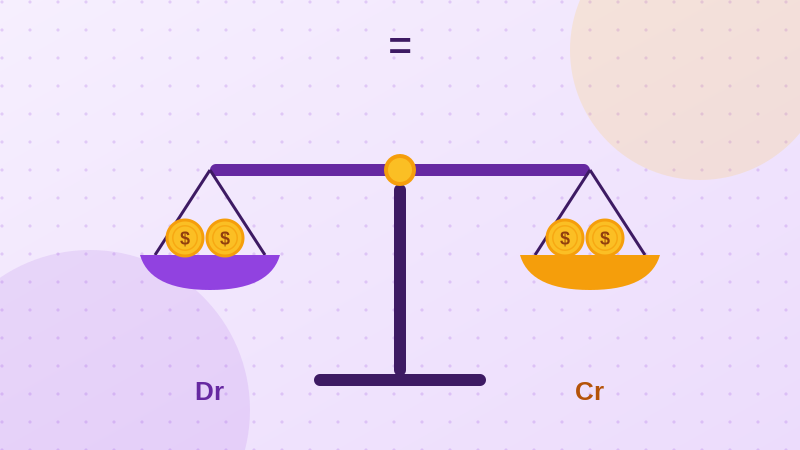
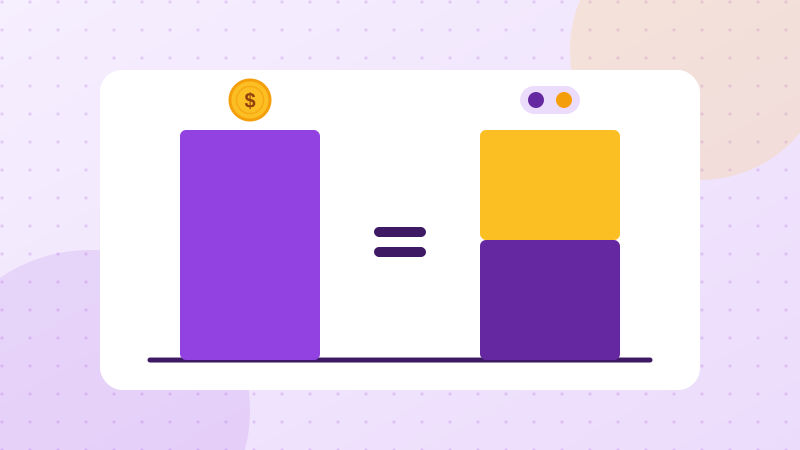
A balance sheet has three parts: assets (what you own), liabilities (what you owe) and equity (the owners' share). Assets always equal liabilities plus equity.
Four questions
- Do I have enough cash? Compare cash and bank with the debts falling due soon.
- What is my money tied up in? If it is mostly in credit and stock, cash gets tight.
- How much do I owe? To suppliers and others, and how much falls due soon.
- Has my equity grown or shrunk? Compare with the end of the last period.
Warning signs
- Customer credit grows larger year after year.
- Debts due soon exceed cash.
- Stock keeps rising but sales do not.
What a balance sheet is, and what it is not
A balance sheet is a photograph of the business on one particular day. It lists what the business owns, what it owes and what is left for the owners, all at the end of that day. It says nothing about how the business performed over the month; that is the job of the income statement. Think of the balance sheet as a picture and the income statement as a film. You need both, but the picture is the one that tells you whether the business can survive next month.
The two sides must always agree, because they describe the same business from two angles: what it has, and who has a claim on it.
How to read the layout
Most balance sheets list assets first, ordered from the most liquid to the least, then liabilities from the nearest due date to the furthest, then equity.
- Current assets: cash, bank, customers (receivables), stock, prepaid expenses. Expected to turn into cash within a year.
- Fixed assets: vehicles, equipment, buildings, shown after depreciation.
- Current liabilities: suppliers, salaries payable, taxes due, short loans. Due within a year.
- Long-term liabilities: loans due later than a year.
- Equity: the owner’s capital, retained profit from earlier years, profit of this year, less drawings.
A sample balance sheet
Here is a small trader’s balance sheet at the end of a month. All numbers are made up and in afghani.
- Cash and bank: 350,000.
- Customers: 600,000.
- Stock: 900,000.
- Vehicle (after depreciation): 800,000.
- Total assets: 2,650,000.
- Suppliers: 700,000.
- Salaries and taxes payable: 150,000.
- Bank loan: 400,000.
- Total liabilities: 1,250,000.
- Equity: 1,400,000 (capital 1,000,000 and profit kept in the business 400,000).
- Total liabilities and equity: 2,650,000, which equals total assets.
Question 1: Do I have enough cash?
Compare the cash and bank against the debts that fall due soon. In the example, cash is 350,000, while suppliers (700,000) and salaries and taxes (150,000) are 850,000 together and are normally due within weeks. The business cannot pay them from cash alone; it depends on collecting from customers. That is not necessarily a problem, but it tells you that collections are urgent.
Here current assets are 350,000 + 600,000 + 900,000 = 1,850,000, and current liabilities are 700,000 + 150,000 = 850,000 (taking the loan as long-term). The ratio is 1,850,000 ÷ 850,000 = 2.18. As a rough guide, a ratio above 1.5 suggests a healthy cushion, and below 1.0 is a warning. But the quality of the assets matters: stock that is slow to sell is not as good as cash.
Question 2: What is my money tied up in?
Look at the biggest assets. In the example, stock (900,000) and customers (600,000) are 57% of everything the business owns, which is typical for a trader. The question is whether that is the right amount. If stock grows faster than sales, money is being tied up on the shelf. If customer balances grow faster than sales, customers are paying more slowly. Each extra 100,000 AFN in stock or receivables is 100,000 AFN that is not available for anything else.
Question 3: How much do I owe, and to whom?
Total liabilities are 1,250,000, against equity of 1,400,000. The ratio of debt to equity is 0.89, so for every afghani of the owner’s money there is almost an afghani of other people’s money. A low ratio means the business is mostly financed by its owners; a high ratio means that lenders and suppliers carry much of the risk, and the business is more sensitive to a bad season. Look also at the mix: supplier credit is cheap and short term, a bank loan is costlier and has a fixed instalment.
Question 4: Has my equity grown?
Compare equity with the previous balance sheet. If it rose, the business earned more than the owners took out. If it fell, either the business made a loss or the drawings were too large. In the example, if equity was 1,330,000 at the end of last month, the increase of 70,000 AFN is the profit of the month less any drawings. Growth in equity is the best single sign that the business is building real value.
More signs to look for
- Negative balances: a negative stock, a negative cash balance or a customer with a credit balance usually means an entry in the wrong place.
- Old receivables: if a large part of customer balances is more than 90 days old, the asset may be overstated.
- Stock that has not moved: it may be worth less than its cost.
- Loans that keep growing while equity does not.
- Large “other” or “miscellaneous” balances that nobody can explain.
- A fixed asset list with nothing depreciated.
Warning signs in numbers
- Current ratio below 1.0: current debts exceed current assets.
- Customer balances rising faster than sales for three months in a row.
- Stock rising while sales are flat or falling.
- Equity falling for two periods.
- Debt to equity above 2: the business is mostly financed by others.
A five-minute routine
- Check that total assets equal total liabilities and equity. If not, something is wrong with the report, not the business.
- Look at cash, customers and stock: have they moved a lot since last month, and do you know why?
- Look at suppliers and loans: what is due in the next 30 days, and is there cash to cover it?
- Look at equity: did it grow, and by about how much profit?
- Write one sentence: “This month the business is stronger/weaker because …”.
How NextBook helps
In NextBook the balance sheet is built from the same ledger as every other report, so it always agrees with your invoices, bills, receipts and payments. You can choose any date, compare it with an earlier date, and click through any line to the accounts and documents behind it. Looking at the balance sheet and the income statement side by side once a month is one of the best habits you can build.
Four questions and five minutes will not make you an accountant. But they will make you a better-informed owner, and an owner who asks the right questions of the numbers every month is hard to surprise.