
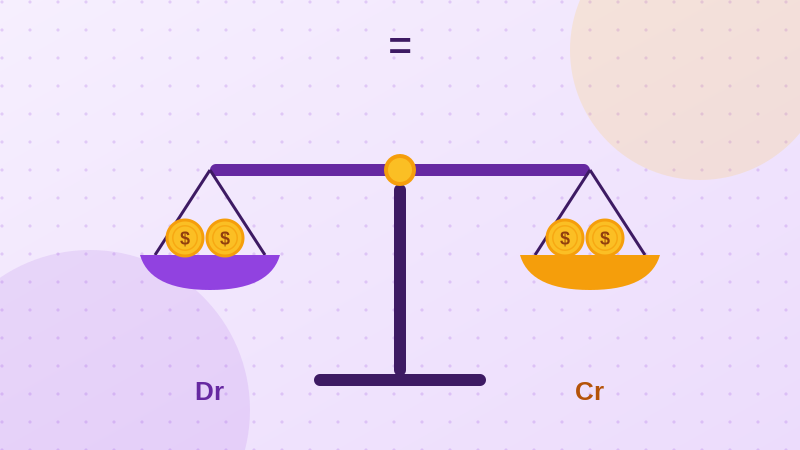
When you sell goods for cash, two things change: your cash goes up and a sale is recorded. If you write only one of them, the books fall out of balance. Double entry means every transaction is always written from both sides.
Three short examples
- A cash sale of 10,000 AFN: cash goes up by 10,000 (debit) and sales income of 10,000 is recorded (credit).
- The same sale on credit: instead of cash, what the customer owes you goes up by 10,000 (debit) and income is recorded (credit).
- Paying 2,000 rent from the till: rent expense of 2,000 (debit) and cash goes down by 2,000 (credit).
What is it good for?
Total debits always equal total credits. If they do not, something is wrong and you know to look for it. The balance sheet and the profit and loss report are built from this same ledger. (The numbers in these examples are made up.)
The two sides have names: debit and credit
Accountants call the two sides of an entry debit and credit. The words sound strange, but they only mean left and right. A debit is an entry on the left side of an account and a credit is an entry on the right side. They do not mean “good” or “bad”, and they do not mean that someone owes you or you owe someone. Every entry has at least one debit and at least one credit, and the total of the debits must always equal the total of the credits. That one rule is the whole safety net of the method.
What a debit or credit does to an account depends on the type of account. Assets and expenses grow with a debit and shrink with a credit. Liabilities, equity and income grow with a credit and shrink with a debit. You do not need to memorise this, because NextBook picks the sides for you when you record a sale, a purchase or a payment. But it helps to know why the system behaves the way it does when you read a ledger.
- Cash received: debit cash (an asset grows).
- Sale made: credit sales (income grows).
- Goods bought on credit: debit stock (an asset grows) and credit the supplier (a liability grows).
- Rent paid: debit rent expense (an expense grows) and credit cash (an asset shrinks).
A full example from a small shop
Take a trader who starts the month with 500,000 AFN in cash and nothing else. All numbers here are made up. During the month five things happen, and each one is written twice.
- The owner puts in 500,000 AFN: debit cash 500,000, credit owner’s capital 500,000.
- The shop buys goods for 300,000 AFN in cash: debit stock 300,000, credit cash 300,000.
- It sells goods that cost 120,000 AFN for 180,000 AFN in cash: debit cash 180,000, credit sales 180,000, and then debit cost of goods sold 120,000, credit stock 120,000.
- It pays 20,000 AFN for rent: debit rent expense 20,000, credit cash 20,000.
- It buys 50,000 AFN of goods on credit from a supplier: debit stock 50,000, credit supplier payable 50,000.
Now add it up. Cash is 500,000 − 300,000 + 180,000 − 20,000 = 360,000 AFN. Stock is 300,000 − 120,000 + 50,000 = 230,000 AFN. The shop owes the supplier 50,000 AFN. The owner’s capital is 500,000 AFN, and the profit for the month is 180,000 − 120,000 − 20,000 = 40,000 AFN. On the left side the shop has 360,000 + 230,000 = 590,000 AFN of assets. On the right side it has 50,000 + 500,000 + 40,000 = 590,000 AFN of liabilities and equity. The two sides agree to the last afghani, and nobody had to check it by hand.
This line is called the accounting equation, and every entry keeps it true. When you buy goods with cash, one asset grows and another shrinks, so the total stays the same. When you borrow, an asset and a liability grow by the same amount. When the business earns profit, assets grow and equity grows by the same amount. There is no way to change one side without the other.
What the notebook cannot do
Most small traders start with a single notebook: money in, money out. It works while there are few transactions. Then problems appear. A sale on credit is written as if the money was received. A purchase is written as an expense, so the stock on the shelf is invisible. A payment to the supplier is written but the invoice stays open in the notebook. After a few months nobody can say whether the notebook is right, because nothing in it checks itself.
Double entry fixes this by making the book test itself. If someone writes only half of an entry, the totals no longer match and the mistake shows up immediately, instead of months later at tax time or when a partner asks to see the accounts. It also gives every transaction a second description. A purchase is not only “money out”; it is also “stock in”, and that second view is what lets you read a balance sheet, a stock value or a profit figure from the same data.
Common mistakes the method catches
- Writing an amount on one side only. The trial balance will not balance.
- Swapping the numbers, for example 54,000 instead of 45,000. The difference is always divisible by nine, a classic clue.
- Posting to the wrong account, such as rent to stock. The totals still agree, so this one needs a review of the account, not just the total.
- Forgetting to record a supplier invoice. The payment looks like an expense with no matching purchase.
How NextBook does it for you
In NextBook you never choose debits and credits by hand for everyday work. You enter an invoice, a receipt or a payment in a form that looks like the paper document you already know, and the system creates the matching entries in the background. The invoice raises the customer’s balance and the sales account, the receipt lowers the balance and raises cash or the bank. If one half of the entry cannot be made, for example because the account is missing, the document is not posted and you see why.
Once a document is posted it is locked. To change it you reverse it, and the reversal is itself a pair of entries, so the history stays complete. That is the reason an auditor can follow every number back to a document, and the reason you can trust the trial balance without checking each line yourself.
A short way to practise
For one week, take every transaction in your shop and ask two questions: what did I receive, and what did I give? Write both answers down. A sale gives goods and receives cash or a promise to pay. A rent payment gives cash and receives the use of the shop. A loan from a friend receives cash and gives a duty to repay. After seven days you will see the pattern, and the screens in NextBook will look familiar.
Double entry is not extra work for its own sake. It is the cheapest way ever invented to make a set of books check itself. Learn the idea once, let the system do the writing, and spend your time on the part that matters: reading what the numbers say about your business.