
All the accounts of a company, small or large, fit into five groups. Two of them appear on the balance sheet, two on the profit and loss report, and one bridges the two.
The five groups
- Assets: everything you own: cash, bank, stock in the warehouse, what customers owe you.
- Liabilities: everything you owe: suppliers, unpaid wages.
- Equity: the owners' share: starting capital and retained profit.
- Income: what comes in from sales and services.
- Expenses: the cost of running the business: rent, power, wages, transport.
How they relate
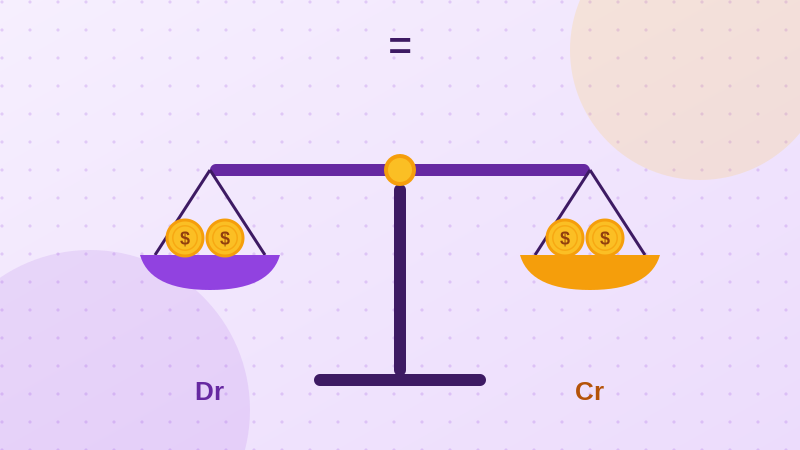
This equation always holds. Income increases equity and expenses reduce it. If income is higher than expenses at the end of the year, your equity has grown.
Assets: what the business owns or is owed
An asset is something that has value to the business and that it controls: cash in the drawer, money in the bank, goods on the shelf, a truck, a shop fitting, and the money customers still owe you. The last one surprises many traders, but a customer’s unpaid invoice is an asset because it is a right to receive money. Assets are usually split into current ones, which will turn into cash within a year (cash, bank, receivables, stock), and fixed ones, which stay in the business for years (vehicles, equipment, buildings).
When you read an asset account, ask one question: is this really here, and is it really worth what the books say? A cash balance that does not match the drawer, a stock value that does not match the shelf, or a customer balance that nobody will ever pay are all asset problems.
Liabilities: what the business owes
A liability is a duty to pay someone later: a supplier invoice not yet paid, a bank loan, salaries earned but not yet paid, a customer’s advance payment for goods you have not delivered, tax due to the government. Like assets, liabilities are split into those due within a year and those due later.
Liabilities are not bad by themselves. Supplier credit lets a trader hold more stock than the cash in the drawer would allow. The danger is only when the amount due soon is larger than the money and the sales expected soon, and that is exactly what a list of liabilities, ordered by due date, shows you.
Equity: what is left for the owner
Equity is the owner’s share: what would be left if the business sold all its assets and paid all its debts. It has three common parts. The first is the capital the owner put in. The second is the profit kept in the business from earlier periods. The third is the profit of the current period. Money the owner takes out for personal use, called drawings, reduces it.
This is why a business that makes losses slowly eats its own equity, and why a business with high equity can survive a bad season. Partners and banks look at this number first because it shows how much of the business really belongs to the owners.
Income: what the business earns
Income, also called revenue, is the value the business earns from its activity during a period. For a trader the main income is sales. Other income may include a commission, an interest payment received, rent from a sublet room, or a gain on exchange rates. Income increases equity because it brings in value that did not exist before.
Two points matter here. First, income is not the same as cash received. A sale on credit is income today, even if the money comes next month. Second, money that is not earned is not income. A loan from a bank or a deposit from a customer brings cash but is a liability, not income. Mixing these up makes a business look better than it is.
Expenses: what it costs to earn
Expenses are the costs of running the business during a period: rent, wages, electricity, transport, phone, advertising, bank charges, and the cost of the goods that were sold. Expenses reduce equity. Profit is simply income minus expenses.
Buying a truck is not an expense, even though money left the bank. It is the exchange of one asset (cash) for another (a truck). Only the part of the truck used up each year becomes an expense, and that is called depreciation. In the same way, buying goods for the shelf is not an expense until they are sold; at that moment the cost moves from stock to cost of goods sold.
Putting the five together: one month, five accounts
Consider a simple month. The owner puts in 400,000 AFN (equity grows, cash grows). The shop buys goods for 250,000 AFN, paying 150,000 AFN now and the rest on credit (stock grows by 250,000, cash falls by 150,000, a liability of 100,000 appears). It sells half of those goods for 190,000 AFN in cash (income 190,000, cash grows, and an expense of 125,000 moves out of stock as cost of goods sold). It pays 15,000 AFN for rent (expense, cash falls). All numbers are made up.
- Assets: cash 400,000 − 150,000 + 190,000 − 15,000 = 425,000; stock 250,000 − 125,000 = 125,000; total 550,000.
- Liabilities: supplier 100,000.
- Equity: capital 400,000 plus profit (190,000 − 125,000 − 15,000 = 50,000) = 450,000.
- Check: 100,000 + 450,000 = 550,000, which equals the assets.
Notice that income and expenses never appear on the balance sheet by name. They are collected during the period and their difference, the profit, flows into equity when the period closes. That is why we say the income statement explains the change in equity between two balance sheets.
Which report uses which accounts
- Balance sheet: assets, liabilities and equity at one date. It answers: what do we have, what do we owe, what is ours?
- Income statement (profit and loss): income and expenses over a period. It answers: did we earn more than we spent?
- Trial balance: all five groups in one list, used to check that debits equal credits.
Common mistakes
- Recording a loan received as income. It is a liability.
- Recording the owner’s personal withdrawal as an expense. It is a reduction of equity.
- Recording a purchase of goods as an expense on the day of purchase. It is an asset until sold.
- Leaving customer advances in income. Until the goods are delivered they are a liability.
- Forgetting accrued expenses, such as salaries earned but not paid, so the liabilities look smaller than they are.
How NextBook uses the five types
Every account in NextBook has a type, and the type decides where the account appears in the reports. When you create an account you choose its type once, and from then on the balance sheet and the income statement are built from it without any manual work. Invoices, bills, receipts and payments post to accounts that already have a type, so a sale always lands in income and a rent payment always lands in expenses.
If you read only one thing in your accounts every month, read the five totals: assets, liabilities, equity, income and expenses. If they make sense together, the details are usually right. If they do not, the grouping is the first place to look.