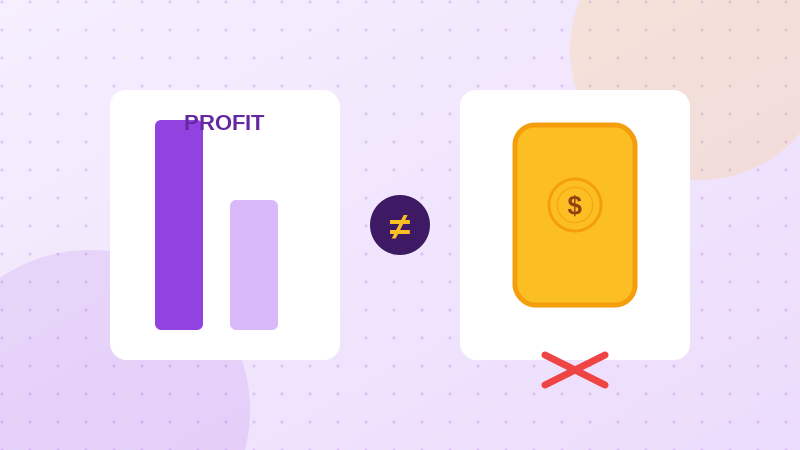
This surprises many owners: the report says we made a profit this month, but there is no money in the bank. Both numbers are right.
Where did the money go?
- Into customer credit that has not been collected yet.
- Into new goods you bought for future sales, sitting in the warehouse.
- Into debts and instalments you paid.
- Into the owners' drawings.
Two reports, two questions
The profit and loss report asks "is our business profitable?" and the cash and bank balance asks "can we pay wages tomorrow?". Look at both.
A story every trader knows
A trader has a very good year. Sales are up by a third, the margins hold, and the accountant reports a profit of 600,000 AFN. In the same week, the trader cannot pay a supplier because the bank account is nearly empty. The partner asks the obvious question: if we made 600,000 AFN, where is it? The answer is that profit and cash are two different measurements of the same business, and they only agree in the very simplest cases.
Profit is an opinion about performance: the value of what you sold minus the cost of earning it. Cash is a fact about the bank and the drawer. Understanding why they differ is one of the most useful things a business owner can learn, because it explains how profitable companies fail, and how to prevent it.
Six places where profit hides
Between the profit figure and the bank balance there are a small number of items. They are always the same ones. Once you know them, you can follow any difference.
- Customers who have not paid. Sales are recorded as income when the invoice is issued, but the cash comes when the customer pays. If receivables grow by 400,000 AFN, then 400,000 AFN of profit is not yet in the bank.
- Stock that was bought but not sold. A purchase of goods is not an expense until the goods are sold. If you buy 300,000 AFN more stock than you sell, cash falls and profit is untouched.
- Suppliers who have not been paid. The opposite helps cash: if you owe suppliers 200,000 AFN more than last month, cash is 200,000 AFN higher than it would otherwise have been.
- Assets bought. A truck or a shop fitting is not an expense; only a part of it, depreciation, is. A purchase of 500,000 AFN takes 500,000 AFN of cash and lowers profit only by the year’s depreciation.
- Loans and capital. Borrowing brings cash but not profit, and repaying the loan takes cash but, apart from the interest, is not an expense. The same is true for the owner’s capital and drawings.
- Non-cash expenses. Depreciation reduces profit without any cash leaving the business.
A simple bridge from profit to cash
You can build this bridge for any period. Start with the profit and adjust for each of the items above. Here is a worked example for one quarter. All numbers are made up.
- Profit for the quarter: +600,000 AFN.
- Add back depreciation (no cash left): +40,000 AFN.
- Increase in customer balances (sales not yet collected): −400,000 AFN.
- Increase in stock (goods bought, not sold): −250,000 AFN.
- Increase in supplier balances (goods received, not yet paid): +180,000 AFN.
- Cash from operations: 600,000 + 40,000 − 400,000 − 250,000 + 180,000 = +170,000 AFN.
- Purchase of a delivery vehicle: −350,000 AFN.
- Bank loan received: +200,000 AFN.
- Owner’s drawings: −100,000 AFN.
- Change in cash: 170,000 − 350,000 + 200,000 − 100,000 = −80,000 AFN.
So a quarter with a profit of 600,000 AFN ends with 80,000 AFN less cash. Each line explains the gap. The two largest are the money still owed by customers and the stock that the trader chose to build up. Those are decisions, and decisions can be changed.
Growth consumes cash
The faster a trading business grows, the more cash it needs, because it must buy stock and give credit before it gets paid. A business that doubles its sales without extra financing may find itself with a record profit and an empty bank account. This is sometimes called overtrading. It is one of the most common reasons good businesses get into trouble, and it is easy to miss because the profit figure looks wonderful.
The remedy is to plan growth together with cash. Before you take on a big order or a new customer on long credit, ask how much cash the order will need, for how long, and where it will come from. Sometimes the right decision is to grow more slowly, to ask for a deposit, or to shorten the credit terms.
Two reports, two questions
The income statement answers: did we earn more than we spent in this period? The cash flow view answers: how much money came in and went out, and why is the bank balance what it is? Neither is better than the other. A business can be profitable and short of cash, or unprofitable and flush with cash from a loan or from selling assets, and both situations are dangerous in different ways.
Look at both every month. Profit tells you whether the business model works. Cash tells you whether the business can survive to see the model working.
Practical ways to improve cash without changing profit
- Collect faster: send statements on time, call overdue accounts, offer a small discount for early payment where it pays.
- Hold less stock: stop reordering slow items, sell dead stock at a discount, and keep a smaller safety stock for products with fast delivery.
- Pay suppliers on the due date, not before, unless an early discount is worth taking.
- Ask for deposits on large or special orders.
- Time big purchases for after a strong collection period, not before.
- Keep the owner’s drawings regular and agreed, not random.
A quick check you can do today
Take your last quarter. Write down the profit. Then write down the change in customer balances, stock and supplier balances over the same period. If customer balances and stock grew by much more than supplier balances, you already know where your profit went. If they did not, look at the purchase of assets, loan repayments and drawings.
How NextBook helps
NextBook shows the income statement and the balance sheet for any period, and the customer, supplier, stock, bank and cash balances behind them. Because everything comes from the same entries, the difference between profit and cash can always be explained by looking at the movements in those balances. The receivables ageing and stock reports show which of the six places is taking your cash.