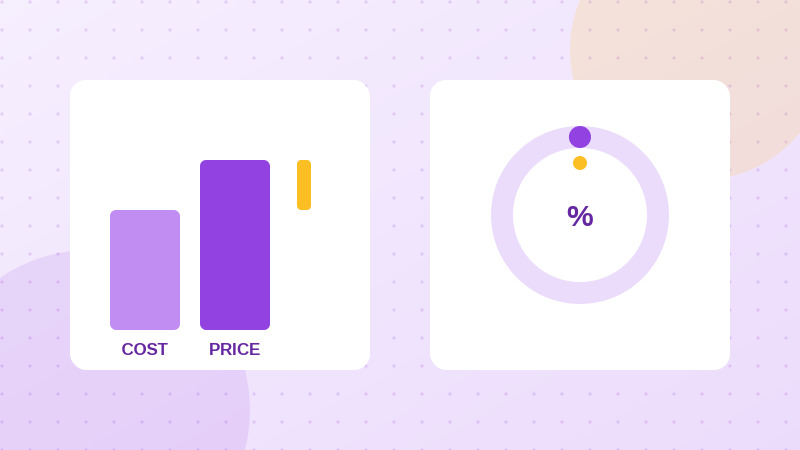
Mixing these two numbers up makes you price lower than you think. You need to know both.
Markup (added to the buying price)
Buy at 100, sell at 130: markup 30%.
Margin (profit from the selling price)
The same buy at 100 and sale at 130: margin about 23%.
Why the difference matters
If your target is 30% of sales and you only add 30% to the cost, you will not reach a 30% margin. For a 30% margin you divide the cost by 0.7. (The numbers in the examples are made up.)
The two formulas side by side
Markup and margin both describe the gap between what you paid and what you charge. They differ only in what the gap is divided by. Markup divides it by the cost. Margin divides it by the selling price. Because the selling price is always bigger than the cost, the margin is always a smaller percentage than the markup, and the difference grows as the numbers grow.
Take a product that costs 100 AFN and sells for 130 AFN. The profit is 30 AFN. The markup is 30 ÷ 100 = 30%. The margin is 30 ÷ 130 = 23.1%. Same product, same profit, two honest numbers. The mistake is to use one as if it were the other.
A table you can keep in your head
Here is how the two numbers relate for common cases. All figures are rounded.
- Markup 10% equals margin 9.1%.
- Markup 20% equals margin 16.7%.
- Markup 25% equals margin 20%.
- Markup 30% equals margin 23.1%.
- Markup 50% equals margin 33.3%.
- Markup 100% equals margin 50%.
The pattern is that margin is markup divided by one plus markup. A 100% markup, selling at double the cost, gives a 50% margin. You can never reach a margin of 100%, because that would mean the goods were free, but you can have a markup of 300% or more.
Why it matters: the most common pricing error
A trader decides he wants a 30% profit and sets prices at cost plus 30%. He then looks at his accounts and sees a margin of only 23%, and wonders why. Nothing is wrong with the accounts. He asked for a markup and expected a margin.
The opposite error is just as common and hurts more. A trader wants a 30% margin. Someone adds 30% to the cost. The result is a margin of 23%, which is seven points short. On a yearly turnover of 10,000,000 AFN, the missing seven points is 700,000 AFN of profit that was planned and never arrived. All numbers are made up.
To get a target margin you must use a different formula. To get a 30% margin on a cost of 100 AFN, the price is 100 ÷ (1 − 0.30) = 142.86 AFN. The markup that was needed is 42.86%, not 30%.
Worked examples
- A bag of rice costs 1,800 AFN. You want a 15% margin. Price = 1,800 ÷ 0.85 = 2,117.6 AFN, roughly 2,120 AFN. A markup of 15% would give 2,070 AFN, a margin of only 13%.
- A shop buys a phone for 9,000 AFN and sells for 10,350 AFN. Markup = 1,350 ÷ 9,000 = 15%. Margin = 1,350 ÷ 10,350 = 13%.
- A wholesaler sells a carton for 5,000 AFN and knows his margin is 12%. The cost must be 5,000 × 0.88 = 4,400 AFN and the markup is 600 ÷ 4,400 = 13.6%.
Which one should you use?
Neither is wrong, but they suit different jobs. Markup is handy at the counter and in price lists, because you start from the cost you know and add a percentage. Margin is the better measure for reports and comparisons, because it is a share of sales, and every other number in the income statement is also measured against sales. When a bank, a partner or an advisor says “gross margin”, they mean the margin on sales.
The best habit is to decide your target in margin terms, convert it to the markup or price that achieves it, and then check the actual margin in the report each month.
Gross margin, net margin and where the costs go
Gross margin looks only at the cost of the goods. It is the sales minus the cost of goods sold, divided by sales. It tells you whether the way you buy and price is working. Net margin takes away all the other costs: rent, salaries, transport, bank charges and so on. It tells you what is left for the owner and for reinvesting.
For example, a shop sells 2,000,000 AFN a month with a cost of goods of 1,500,000 AFN. Gross profit is 500,000 AFN, a gross margin of 25%. Running costs are 380,000 AFN, leaving a net profit of 120,000 AFN, a net margin of 6%. If the shop cuts prices by 5% to win customers, sales fall to 1,900,000 AFN while the cost of the same goods is still 1,500,000 AFN. Gross profit is now 400,000 AFN, a margin of 21%, and after running costs there is only 20,000 AFN left. A 5% price cut took away 83% of the net profit. Small changes in price have big effects.
Costs that are easy to forget in the cost price
- Freight, customs duty and clearing charges on imported goods.
- Loading, unloading and local transport.
- Currency differences if you bought in dollars.
- Breakage, spoilage and shortages that you cannot sell.
- Discounts you give regularly, and returns.
If these are left out, your cost looks lower than it is, your margin looks higher than it is, and your price may be too low. The right cost is the full cost of having the item ready on the shelf, which is also called the landed cost.
How NextBook helps
NextBook records the purchase cost of each product, including the extra costs you add to it, and the selling price on each invoice. Reports show the gross profit and the margin for each product, customer and month, so you can see which items earn what you planned and which do not. You can set your price lists as a markup on cost, then check the resulting margin in the profit reports.