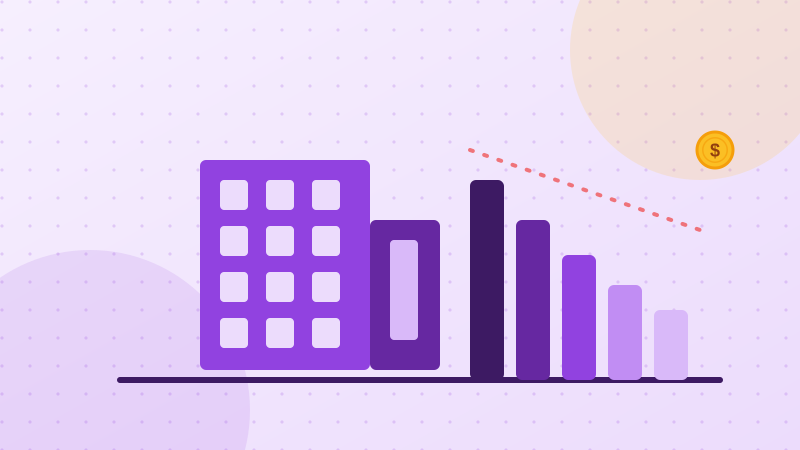
Say you buy a delivery truck for 800,000 afghani. If you record all of it as an expense in that month, you see a huge loss that month and unrealistic profit in later years. But the truck works for five years.
What is depreciation?
Depreciation means dividing the cost of an asset over its useful life. Each year a share of it appears as an expense.
An example
Truck price 800,000, value after 5 years 150,000: annual depreciation (800,000 − 150,000) ÷ 5 = 130,000 afghani. (The numbers are made up.)
What counts as a fixed asset?
- Vehicles and machinery
- Office and shop equipment
- Buildings and lasting improvements
The idea behind depreciation: spreading a cost over the years that benefit
When a trader buys a delivery truck for 1,200,000 AFN, the truck does not help the business in one month only. It will carry goods for years. If the whole 1,200,000 AFN were charged as an expense in the month of purchase, that month would show a huge loss, and the following years would show profits that are higher than the truth, because the truck would be working for free. Depreciation fixes this by charging a share of the cost in each year that the truck is used. This is the matching idea again: the cost of an asset is matched to the income it helps to earn.
Two things are worth remembering. First, depreciation is a way of allocating a cost, not of measuring market value. A truck can be worth more or less on the market than its book value, and that is not what depreciation tells you. Second, depreciation is not a cash payment. The cash left the business on the day of purchase; depreciation only spreads the effect on profit.
Three numbers you need for each asset
- Cost: the full amount needed to bring the asset into use, including delivery, customs duty, installation and registration, not just the invoice price.
- Useful life: how many years you expect to use the asset in the business. It depends on how you use it, not on how long it could last in theory.
- Residual (salvage) value: what you expect to sell it for at the end of its life. It may be zero.
The straight-line method
The most common and simplest method gives an equal amount of depreciation each year.
For the truck: cost 1,200,000 AFN, useful life 5 years, residual value 200,000 AFN. Annual depreciation = (1,200,000 − 200,000) ÷ 5 = 200,000 AFN. Monthly depreciation is 16,667 AFN. All numbers are made up. After one year the truck’s book value is 1,000,000 AFN, after two years 800,000 AFN, and so on until it reaches 200,000 AFN after five years.
Accumulated depreciation and book value
The truck itself stays in the books at its original cost of 1,200,000 AFN. The depreciation charged each year is collected in a separate account called accumulated depreciation, shown as a reduction from the cost. The difference is the net book value (also called carrying amount).
- Year 1: cost 1,200,000; accumulated depreciation 200,000; book value 1,000,000.
- Year 2: cost 1,200,000; accumulated depreciation 400,000; book value 800,000.
- Year 3: cost 1,200,000; accumulated depreciation 600,000; book value 600,000.
- Year 5: cost 1,200,000; accumulated depreciation 1,000,000; book value 200,000 (the residual value).
Each year the entry is the same: a depreciation expense in the income statement, and an increase in accumulated depreciation on the balance sheet. Nothing is paid, and no cash moves.
Other methods
Straight-line is not the only method. The reducing balance (declining balance) method charges a fixed percentage of the remaining book value each year, so the charge is highest in the early years. It suits assets that lose their usefulness quickly, such as computers and vehicles. For example, at 25% reducing balance on the same truck: year 1 is 300,000 AFN (25% of 1,200,000), year 2 is 225,000 AFN (25% of 900,000), year 3 is 168,750 AFN (25% of 675,000), and so on. The units-of-production method links depreciation to usage, such as kilometres driven or hours run, which suits machines whose wear depends on use.
Whatever method you choose, apply it consistently from year to year, and check what your local tax rules allow. Tax depreciation and management depreciation are sometimes different, and you may need to keep both.
What counts as a fixed asset
A fixed asset is a physical item that the business owns, uses for more than one year and does not intend to sell as part of its normal trade. Typical examples are vehicles, shop fittings, shelving, computers, generators, machinery and buildings. Land is a fixed asset but is not usually depreciated.
Most businesses set a minimum value, called a capitalisation threshold, below which items are charged to expense at once even if they will last a while. For a small shop, it might be 5,000 or 10,000 AFN. A 600 AFN calculator is an expense; a 45,000 AFN laptop is an asset. The point is to avoid a long list of tiny assets, and to apply the same rule to everything.
Repairs versus improvements
- Repair and maintenance, which keep an asset working as it was, are expenses: changing the oil, replacing a tyre, fixing a lock.
- Improvements, which add value or extend the life, are added to the asset’s cost: a new engine that lengthens a truck’s life, an extension to the shop.
When in doubt, ask whether the work makes the asset better or longer-lived than before. If it merely restores it to its normal state, it is an expense.
When an asset is sold or scrapped
When you sell an asset, compare the selling price to its book value on that day. If you sell the truck after three years for 700,000 AFN while its book value is 600,000 AFN, you have a gain of 100,000 AFN. If you sell for 500,000 AFN, you have a loss of 100,000 AFN. Remove the asset’s cost and accumulated depreciation from the books, record the money received, and show the gain or loss in the income statement. A gain or loss on disposal is not part of normal trading profit, so it is best shown separately.
Keep a fixed asset register
A register lists every fixed asset with its description, serial number or registration, date of purchase, cost, useful life, residual value, location, and the depreciation to date. It lets you tick off assets at a physical check once a year, discover missing or broken items and keep depreciation calculations clear. Without a register, assets are forgotten, and the balance sheet drifts away from reality.
How NextBook helps
NextBook keeps a fixed asset register with the cost, date and life of each asset and calculates the depreciation each month. It posts the depreciation expense and the accumulated depreciation to the right accounts automatically, shows the book value of each asset, and records the gain or loss when you dispose of one. The result is that the balance sheet shows true values and the income statement carries a fair share of the cost each month.