Suppose you bought an item twice and the price went up. When you sell, your profit depends on which purchase the goods came from. The system works that out for you.
What does FIFO mean?
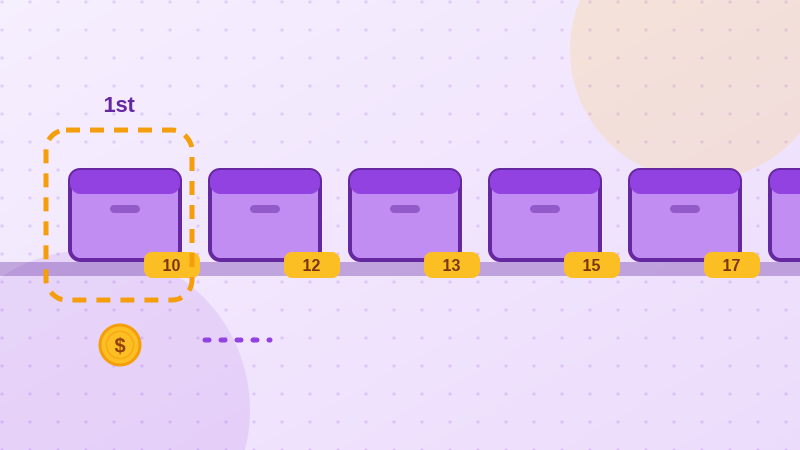
FIFO means first in, first out: the goods that arrived first are sold first, and the cost is that of the purchase they came from.
A simple example
- You bought 10 units at 100.
- Later you bought 10 more units at 120.
- Now you sell 12 units.
The cost of this sale is 10 units at 100 and 2 units at 120, which is 1,240. Not 1,320, and not the 1,200 you would get from an average or a guess. Your profit is calculated from this number. (The numbers in this example are made up.)
Landed costs
If you import goods, freight, customs and other costs are part of the cost of the goods too. If you leave them out, the profit on paper is higher than the real one. In NextBook you add these costs on the purchase bill and they go into the cost price.
Why cost matters more than most traders think
Most traders know their selling prices by heart. Far fewer know their true cost prices, because the cost changes: the supplier’s price moves, the dollar rate moves, the freight changes between shipments. When the cost is wrong, everything built on it is wrong too: the profit on each sale, the value of the stock, the margin you thought you had and the price you decided to charge. A shop can look profitable in the reports and be losing money on its best-selling item, simply because the cost it uses is out of date.
Two ideas fix most of this. The first is a clear rule for which cost applies when you sell (FIFO). The second is a complete cost that includes everything you pay to get the goods ready to sell (landed cost).
The problem FIFO solves
When you buy the same item at different prices at different times, the shelf holds a mix of “cheap” and “expensive” units that look identical. When one is sold, which cost goes into the profit? You need a rule, applied the same way every time. FIFO, first in, first out, says: the oldest units are sold first, so each sale takes its cost from the earliest purchase that still has units left.
FIFO is natural for many goods, such as food, medicine and anything with an expiry date, because the oldest stock should indeed be sold first. For goods that do not spoil, it is still widely used because it is simple, easy to explain to an auditor and produces a stock value close to the current replacement cost, since the units left on the shelf are the most recent purchases.
A longer FIFO example with three purchases
A trader buys sugar in three lots. All numbers are made up.
- 1 March: 100 bags at 2,000 AFN each.
- 10 March: 100 bags at 2,100 AFN each.
- 25 March: 100 bags at 2,300 AFN each.
During March and April the trader sells 160 bags in several sales. With FIFO, the cost of these 160 bags is the 100 bags from the first lot (100 × 2,000 = 200,000) plus 60 bags from the second lot (60 × 2,100 = 126,000), a total of 326,000 AFN. The average cost per bag sold is 326,000 ÷ 160 = 2,037.50 AFN.
What remains on the shelf is 40 bags from the second lot (40 × 2,100 = 84,000) and 100 bags from the third lot (100 × 2,300 = 230,000), a stock value of 314,000 AFN. Notice that the remaining stock is valued at recent prices, which is close to what it would cost to replace.
Suppose the sales were made at 2,600 AFN a bag. Revenue is 160 × 2,600 = 416,000 AFN. Gross profit is 416,000 − 326,000 = 90,000 AFN, a margin of 21.6%. If the trader had used the latest price of 2,300 for all units, he would have calculated a cost of 368,000 AFN and a profit of only 48,000 AFN. If he had used the oldest price of 2,000 for all, the profit would show 96,000 AFN. The same sales give three different profits, depending on the cost rule, and only one rule is applied consistently and fits the real flow of goods.
How the main methods compare
- FIFO: the oldest cost goes to the cost of sales first; remaining stock is at recent cost. In a time of rising prices, it shows a higher profit and a higher stock value.
- Weighted average: every unit has the average cost of all units on hand, updated at each purchase. It smooths out price swings and is simple to understand.
- LIFO (last in, first out): the newest cost goes to cost of sales first. It is not allowed under some accounting standards and is rarely used by small traders.
- Specific identification: you track the actual cost of each individual item, such as a vehicle or a piece of jewellery. It suits unique, high-value goods.
Whatever method you choose, use it consistently. Changing the method from year to year makes comparison meaningless, and it can change taxable profit, so your tax adviser should know which one you use.
Landed cost: the full cost of getting the goods ready
The invoice price from the supplier is only the start. For imported goods, and often for local goods too, there are more costs before the item can be sold: freight and insurance, customs duty and taxes that are not recoverable, port and clearing charges, handling and unloading, and the cost of transport to your warehouse. Together with the invoice price, these make up the landed cost. Under normal accounting rules, these costs belong in the cost of the stock, not in the running expenses for the month.
Why does it matter? Because if you leave them out, the cost of the goods looks lower than it is, so the profit looks higher than it is, and your selling price may be too low. A trader who adds only the invoice price to the books and charges freight and duty as monthly expenses is hiding the real cost of each product.
A landed-cost example
A trader imports 500 cartons of tea at an invoice price of 800 AFN a carton, which is 400,000 AFN. Freight and insurance are 30,000 AFN, customs duty is 40,000 AFN and clearing and local transport are 10,000 AFN. All numbers are made up.
Additional costs total 30,000 + 40,000 + 10,000 = 80,000 AFN. Landed cost is 400,000 + 80,000 = 480,000 AFN, or 960 AFN per carton, 20% more than the invoice price. If the trader planned to sell at 1,000 AFN a carton on the basis of 800 AFN cost, he would expect a 20% margin. On the real landed cost of 960 AFN, the margin is only 4%. That one calculation can be the difference between a profitable import and an unprofitable one.
Sharing the extra costs across the items
When one shipment contains several products, the extra costs have to be shared out. The usual ways are by value (a product that is 30% of the invoice takes 30% of the costs), by quantity, by weight or by volume. Choose the basis that best reflects what causes the cost: freight is often related to weight or volume, and insurance and duty to value. Keep the method consistent and document it.
For example, a shipment holds goods A worth 300,000 AFN and B worth 100,000 AFN, with 20,000 AFN of shared costs. By value, A takes 75% (15,000 AFN) and B 25% (5,000 AFN). The cost of each unit of A and B then includes its share, and the stock is valued at its true landed cost.
How FIFO and landed cost work together
The landed cost raises the cost of each purchase lot, and FIFO then decides which lot’s cost is used when you sell. A lot bought in March with high freight keeps its higher cost until its last unit is sold. This is exactly what you want: each unit carries what it really cost, from the day it arrived to the day it left.
What this does to prices and decisions
- A price list can be built from true cost plus the margin you need. See our article on margin and markup.
- You see which products are really profitable once freight and duty are counted, and which only look profitable.
- When a supplier raises the price or the dollar rate rises, you can see the effect on the next lot, and decide in time whether to raise your prices.
- Stock on the balance sheet is valued fairly, which matters to your bank and partners.
Common mistakes
- Entering only the invoice price and treating freight and duty as monthly expenses.
- Using one cost for the item all year long, ignoring price changes.
- Mixing methods: FIFO for some products, average for others, without reason.
- Forgetting exchange rate effects on the invoice cost.
- Not updating the cost when a late freight or customs invoice arrives.
How NextBook helps
NextBook values stock by FIFO and takes the cost of each sale from the purchase lot it comes from. You add freight, customs and other costs on the purchase bill, and they go into the cost price of the goods, so profit reports show the real margin. For a deeper look at landed costs, with formulas and a worked inventory example, read our full guide on landed cost.