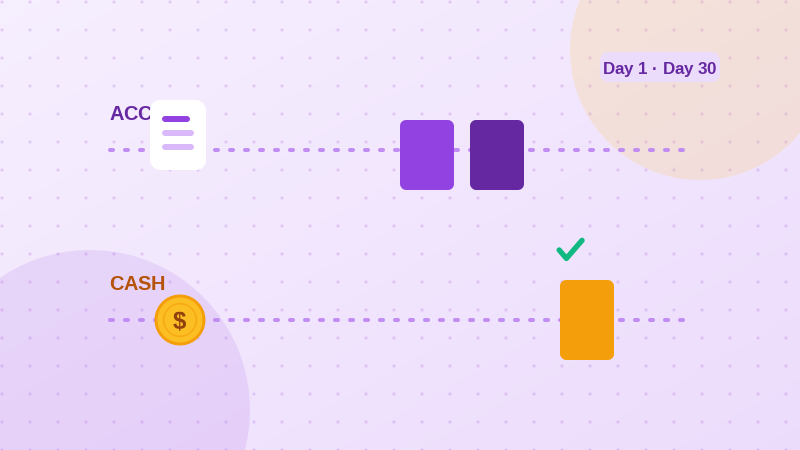
Say you sold goods on credit today and the money arrives a month later. Did you make the sale today or next month? The answer depends on the accounting method.
The cash method
Income is recorded when the money arrives and an expense when the money is paid. It is simple, but it gives an incomplete picture: credit sales and later debts are not visible.
The accrual method
Income is recorded when the sale happens and an expense when it is incurred, whether or not money has moved. What customers owe you and what you owe appear in the books, so the profit for each period is closer to reality.
Which should I choose?
- If most of your sales are cash and you hold little stock or credit, the cash method may be enough.
- If you sell on credit, buy on credit or hold stock, the accrual method gives a truer picture of profit and position.
The same month, two different pictures
The easiest way to understand the two methods is to run one month through both. A trader has the following month. All numbers are made up. On the 5th it buys goods for 300,000 AFN on credit, to be paid next month. On the 10th it sells half of them for 260,000 AFN: 100,000 AFN in cash and 160,000 AFN on credit. On the 20th it pays 30,000 AFN rent in cash. On the 25th it receives 40,000 AFN from a customer for a sale made last month.
Under the cash method the month looks like this: money in is 100,000 + 40,000 = 140,000 AFN; money out is 30,000 AFN for rent (the goods were not paid yet). The profit is 110,000 AFN. It looks like a wonderful month.
Under the accrual method the sale of 260,000 AFN counts, whether paid or not. The cost of the goods sold, half of 300,000, is 150,000 AFN. Rent is 30,000 AFN. The profit is 260,000 − 150,000 − 30,000 = 80,000 AFN. The 40,000 AFN received from last month’s sale is not income this month; it was income last month and now only reduces the customer’s balance.
Two methods, two profits: 110,000 against 80,000. The accrual figure is closer to the truth, because the cash method forgot the cost of the goods that were sold and counted money from last month’s sale as if it were new.
What each method hides
The cash method hides what is owed to you and what you owe. In the month above, the trader is owed 160,000 AFN by customers and owes 300,000 AFN to a supplier. A person who only looks at cash sees a profit and a bank balance and does not see a debt that is due next month. This is how profitable-looking businesses suddenly run out of money.
The accrual method hides almost nothing about the business itself, but it can hide the state of the cash drawer. A business can show a profit under accrual and still have no cash, if customers do not pay. That is why accrual accounting should always be read together with a cash view, such as a bank balance or a cash flow report.
Matching: the idea behind accrual
Accrual accounting follows one idea: record the cost in the same period as the income it helped to earn. The goods sold in March are a March cost even if you paid for them in January. The salary earned in March is a March cost even if you pay it in April. This matching is what makes a monthly profit comparable from one month to another. Without it, a month with a big purchase looks terrible and the next month, with the sales but no purchase, looks wonderful, though nothing changed in the business.
Who must use which method
- A small shop with only cash sales, no stock held for long, no credit and no staff can manage with the cash method.
- A business with credit sales, credit purchases, stock, salaries or loans should use the accrual method for its own management, because decisions depend on seeing the true profit and the debts.
- Banks, investors and larger customers normally expect accrual accounts.
- Tax rules differ by country and by size of business. Ask your tax adviser which method the authorities require for your return. You can keep accrual books for management and still file on the basis the rules require.
Items where accrual makes a visible difference
- Credit sales: income is recorded when the goods are delivered or the invoice is issued, and a receivable is created.
- Credit purchases: stock or an expense is recorded when the goods or service arrive, and a payable is created.
- Prepaid rent or insurance: the payment is an asset first and becomes an expense month by month.
- Salaries earned but not yet paid: an expense and a liability at month end.
- Customer advances: a liability until the goods are delivered, then income.
- Depreciation: the cost of a vehicle is spread over the years it is used.
A practical test for your own business
Take last month. Add up the cash that came in and the cash that went out and note the difference. Then list what customers still owe you, what you still owe your suppliers, and the value of the stock on the shelf. If these three numbers are small compared to the month’s sales, the cash method will not mislead you much. If any one of them is large, the cash view and the real view are far apart, and you need accrual accounting.
Using both views together
The best practice is not to choose one view and forget the other. Use accrual for profit, and cash for survival. Profit tells you whether the business model works. Cash tells you whether you can pay next week’s bills. A business that makes a profit but has no cash is in danger, and a business with cash but a loss is only borrowing time.
Each month, look at three things in this order: the profit under accrual, the change in cash and bank balances, and the difference between the two. The difference is explained by three items you can name: money customers have not paid, money you have not yet paid suppliers, and money tied up in stock.
What NextBook does
NextBook records sales and purchases on the accrual basis automatically. An invoice creates income and a customer balance on the invoice date, and a receipt later reduces the balance. A bill creates the stock or expense and a supplier balance, and a payment later reduces it. You do not move anything by hand at month end.
At the same time the bank and cash accounts show the actual money, and the receivables and payables reports show exactly why the two views differ. You see both pictures from one set of entries.