Every month the rent and wages must be paid. The question is: how much must we sell so that, after paying fixed costs, we at least do not lose?
The formula
An example
Monthly fixed costs are 60,000 afghani and the margin is 20%. Break-even sales: 60,000 ÷ 0.20 = 300,000 afghani a month. Below that you lose and above it you profit. (The numbers are made up.)
How does this number help?
- You learn how risky a slow month is.
- You see how much higher the required sales go if rent or wages rise.
- You see how much a higher margin (better pricing) lowers the required sales.
Fixed and variable costs: the two kinds
To find the break-even point you must first split your costs into two kinds. Variable costs rise and fall with what you sell: the cost of the goods, sales commission, packaging, delivery fuel per trip. If you sell nothing, they are zero. Fixed costs stay roughly the same whatever you sell within a normal range: rent, salaries, electricity, insurance, the loan instalment, the accountant. You pay them even in a month with no sales.
Some costs are in between. A phone bill has a fixed line rental and a variable usage charge. A part-time worker’s pay rises when business is busy. For planning, put each cost where it mostly belongs, or split it into its fixed and variable parts if the amounts are large.
The contribution margin
Each time you sell something, part of the price pays for the variable cost of that item and the rest is left over to pay for the fixed costs and, after that, to become profit. That left-over part is called the contribution. It is the key number in break-even thinking.
For a shop whose goods cost 70% of the selling price and where nothing else varies, the contribution margin is 30%. For every 100 AFN of sales, 30 AFN is left to cover fixed costs and profit.
The break-even formulas
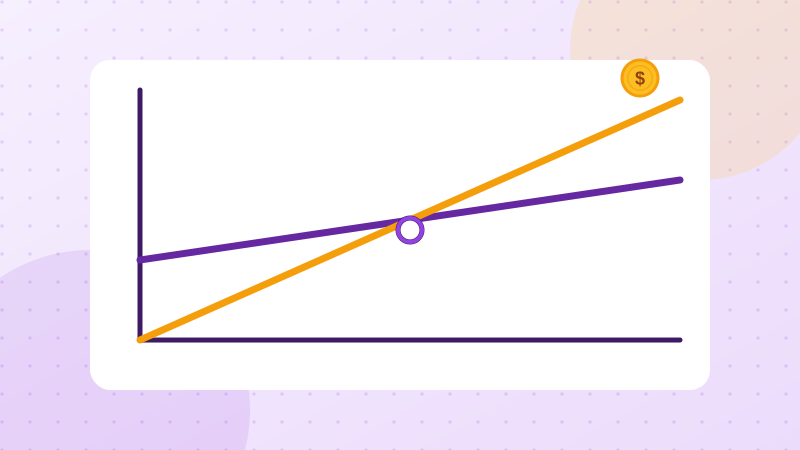
Break-even is the level of sales at which the total contribution exactly equals the fixed costs. Below it you make a loss. Above it every further sale adds to profit.
Example 1: a shop selling many products
A shop has fixed costs of 180,000 AFN a month: rent 50,000, salaries 90,000, utilities 15,000, other 25,000. Its goods cost 75% of the selling price, so its contribution margin is 25%. All numbers are made up.
Break-even sales = 180,000 ÷ 0.25 = 720,000 AFN a month. At sales of 720,000 AFN, the contribution is 180,000 AFN, exactly the fixed costs, and the profit is zero. At sales of 900,000 AFN the contribution is 225,000 AFN, so the profit is 45,000 AFN. At sales of 600,000 AFN the contribution is only 150,000 AFN, and the shop loses 30,000 AFN.
Example 2: one product, counted in units
A trader sells a 50 kg bag of flour for 2,400 AFN. The bag costs 2,000 AFN, and the variable cost of delivery and handling is 100 AFN per bag. The contribution is 2,400 − 2,000 − 100 = 300 AFN per bag. Fixed costs are 90,000 AFN a month. Break-even = 90,000 ÷ 300 = 300 bags a month. About 10 bags a day, on 30 trading days, is the level at which the shop neither wins nor loses.
The margin of safety
The distance between your actual sales and the break-even sales is called the margin of safety. If break-even is 720,000 AFN and you sell 900,000 AFN, the margin of safety is 180,000 AFN, or 20% of sales. This tells you how far sales can fall before you start to lose money. A business with a margin of safety of 5% is fragile. A business with 30% can survive a bad month.
A target profit
The same logic tells you what to sell to reach a target. Add the profit you want to the fixed costs and divide by the contribution margin. If the shop above wants a profit of 90,000 AFN a month, it needs sales of (180,000 + 90,000) ÷ 0.25 = 1,080,000 AFN. If the owner thinks that is too high, he knows he must raise the margin, cut the fixed costs or accept a lower profit.
Ways to lower the break-even point
- Raise prices slightly, if the market allows. A 3% price rise on a 25% margin lifts the margin to about 27.2% and cuts break-even by roughly 8%.
- Buy better. A lower purchase cost raises the contribution on every sale.
- Cut fixed costs: renegotiate rent, share a warehouse, review salaries and subscriptions.
- Change the mix: push the products with the highest contribution, not only the ones that sell most.
- Turn fixed costs into variable ones where possible, for example pay commission instead of a higher fixed salary.
How the number can mislead
Break-even is a simple tool and it has limits. It assumes that prices, costs and the product mix stay the same as sales change, which is rarely exact. Fixed costs may step up if you grow past the capacity of your shop. A discount to win volume changes the contribution margin. And the calculation says nothing about cash: a business can pass break-even on paper and still run out of money if customers pay late or stock is built up.
Using break-even in decisions
- Opening a second shop: add its fixed costs and ask how much extra sales are needed just to cover them.
- Hiring a person: the salary is a new fixed cost; how many extra sales does it need?
- Taking a discount request from a large customer: what does the lower margin do to the number of units you must sell?
- Moving to a bigger shop: will the higher rent be covered at your realistic sales?
How NextBook helps
To use break-even you need real numbers for your margin and your fixed costs. NextBook gives you the margin by product and for the whole month, and the expense report shows your fixed costs by category. With those two reports, a break-even is a ten-minute calculation, and you can repeat it each month to see how the safety margin changes.