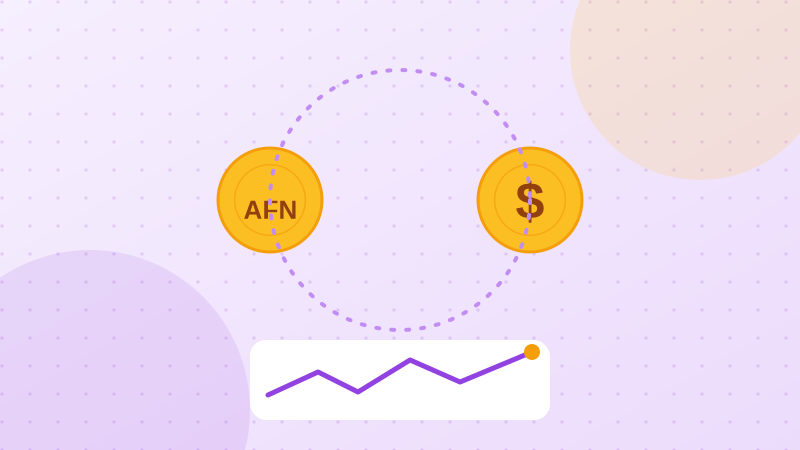
In Afghanistan many traders work in two currencies. If you do not record the exchange rate properly, you can lose money without knowing it.
An example
Today you buy goods for 1,000 dollars when a dollar is 68 afghani: 68,000 afghani. Two weeks later when you pay, the rate is 70 and you must give 70,000 afghani. That is a 2,000 afghani loss from the rate, not from the goods. (The numbers are made up.)
What to record
- The amount of the deal in the original currency (dollars).
- The exchange rate on the day of the deal.
- The afghani equivalent your books are kept in.
The exchange difference
Each time a foreign-currency receivable or payable is settled at a different rate, the difference becomes an exchange gain or loss. Look at it apart from your sales profit, so you know whether the goods were profitable or only the rate was.
Why two currencies make accounting harder
Many Afghan traders buy in dollars, yuan or dirhams, sell in afghani, and keep money in more than one currency. The books must be kept in one currency, called the base currency, which for most businesses here is the afghani. Every transaction in another currency has to be translated into the base currency at some exchange rate, and because rates move, the same amount of foreign currency can be worth different amounts of afghani at different times. That movement is where exchange differences come from.
The rule to remember is simple. A foreign-currency amount is recorded at the rate on the day it happens. If the amount is still open later, its afghani value may change, and the change is a gain or a loss, not a normal sale or expense.
Three kinds of foreign-currency items
- Monetary items that will be settled in cash: foreign-currency bank accounts, cash in dollars, customers who owe dollars, suppliers you owe in dollars. These are re-valued when the rate changes.
- Non-monetary items: stock, vehicles and equipment bought in foreign currency. These stay at the rate on the day of purchase and are not re-valued.
- Income and expenses: recorded at the rate on the day of each transaction. Averages can be used when rates are stable.
A full example: buying goods in dollars
On the 1st, a trader buys goods worth 10,000 USD on credit from a supplier, when 1 USD is 70 AFN. The goods are recorded in stock at 700,000 AFN and the supplier at 10,000 USD, worth 700,000 AFN. All numbers are made up.
On the 30th, the rate is 72 AFN. The supplier still has to be paid 10,000 USD, but that is now 720,000 AFN. The business owes 20,000 AFN more than it recorded. Stock stays at 700,000 AFN, because that is what the goods cost on the day of purchase. The extra 20,000 AFN is an exchange loss, recorded as an expense for the month.
On the 5th of next month the trader pays 10,000 USD at a rate of 71 AFN, which costs 710,000 AFN. The supplier balance was 720,000 AFN, so 10,000 AFN of the earlier loss reverses and becomes a gain. In total, over the life of the invoice, the exchange effect was a loss of 10,000 AFN (710,000 paid against 700,000 recorded at the start), shown as a 20,000 AFN loss in the first month and a 10,000 AFN gain in the second.
A second example: selling in dollars
A trader sells goods for 5,000 USD on credit when the rate is 70 AFN, recording sales of 350,000 AFN and a customer balance of 350,000 AFN. At month end the rate falls to 69 AFN. The 5,000 USD that the customer owes is worth only 345,000 AFN, so there is an exchange loss of 5,000 AFN. When the customer pays at a rate of 69.5 AFN, the trader receives 347,500 AFN, and 2,500 AFN of the loss comes back as a gain. The sale itself, 350,000 AFN, does not change.
This is the key idea: the profit on the trade and the result of the exchange rate are two different things. Mixing them gives a false picture of how good the trading is.
Realised and unrealised differences
A realised exchange difference arises when the foreign amount is actually paid or received. An unrealised one arises when you re-value an open balance at the end of a period without any settlement yet. Both go to the income statement. The unrealised part may reverse next month if the rate moves back, so many traders look at them separately: realised gains and losses are money, unrealised ones are only an estimate of what money you would get today.
Re-valuing at month end
To produce honest accounts, you re-value all foreign-currency bank balances, customer balances and supplier balances at the closing rate on the last day of the month. For each, you compare the book value in afghani to the foreign amount multiplied by the closing rate. The difference is posted as a gain or loss. The next month starts again from the original rate, and the old unrealised amount reverses.
- Choose a closing rate and note its source: the central bank rate, the market rate, or the rate of a money exchanger you use.
- List every foreign-currency balance with its foreign amount.
- Multiply each by the closing rate to get the new afghani value.
- Subtract the book value, and record the difference as a gain or a loss.
- Keep the working paper for the audit.
Which rate to use
Any rate you use should be reasonable and consistent. Many businesses use the rate published by Da Afghanistan Bank or the market exchange rate in Kabul, others use the rate they actually paid at the money exchanger. What matters is that you record the source, apply it the same way every time, and do not change the method without a reason. If you pay a money exchanger a fee for the conversion, record the fee as a bank or exchange charge, separate from the exchange difference.
Practical advice for traders
- Keep a separate bank or cash account for each currency, so the foreign balance is easy to see.
- Record every transaction with the currency and the rate at the time, not later.
- Price your goods with a rate you can defend, and review prices when the rate moves sharply.
- If you can, match: if you owe 50,000 USD to suppliers and you hold 50,000 USD in the bank, a rate change hurts one and helps the other.
- Watch the net position. A business that owes more dollars than it holds is exposed if the dollar rises.
How NextBook helps
NextBook keeps the base currency and records each document in its own currency with the rate on its date. Foreign-currency customer, supplier and bank balances can be re-valued to a closing rate, and the exchange gain or loss posts to its own accounts automatically. Because the difference is shown separately from sales and cost of goods, the profit on trading stays clear.